Why Is Being a Voter So Important?
The union election process is overseen by the National Labor Relations Board (NLRB), a government agency, rather than the union or the company themselves. Employees will be notified of the time and place to vote. At the polling place, an NLRB agent, along with representatives from the company and the union (who are typically employees themselves), will be present to observe the election and confirm voter eligibility. These representatives cannot see or find out how an individual voted.
The voting process: When you arrive to vote, you’ll provide your name to the NLRB agent, receive a ballot, and your name will be checked off a list. This prevents anyone from voting twice or under another person’s name. The election uses a secret ballot, meaning no one will know how you vote unless you choose to tell someone. It’s crucial not to put your name or any other markings on the ballot besides your vote, as doing so will cause it to not be counted. The ballot is straightforward:
- you mark “Yes” if you wish to be represented by the union,
- or “No” if you do not wish to be represented.
After marking your ballot, you fold it and deposit it into a sealed box.
The votes are counted by the NLRB representative, with both union and company representatives observing. Once counted, the outcome is announced, and the ballots are sealed and become the property of the U.S. government.
Why You Should Be a Voter.
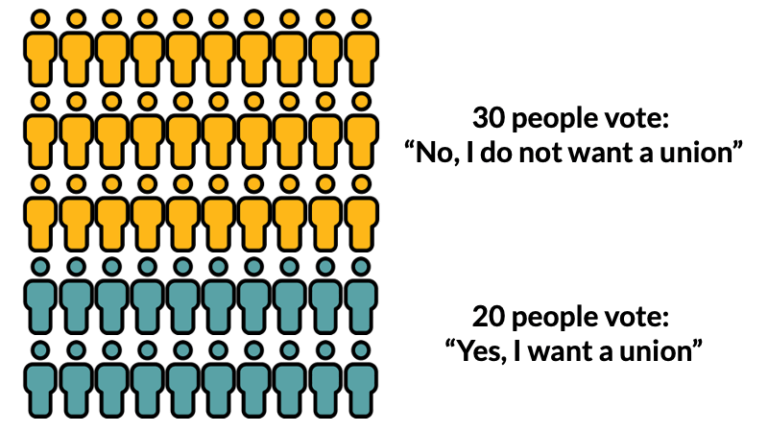
In this first example, in a unit of 50 employees, all of them turn out to vote. 30 vote NO – meaning they do NOT want to be represented by the union. The remaining 20 vote YES, asking to be represented by the union. In this case, each person is heard, and the majority rules that there will be no union.
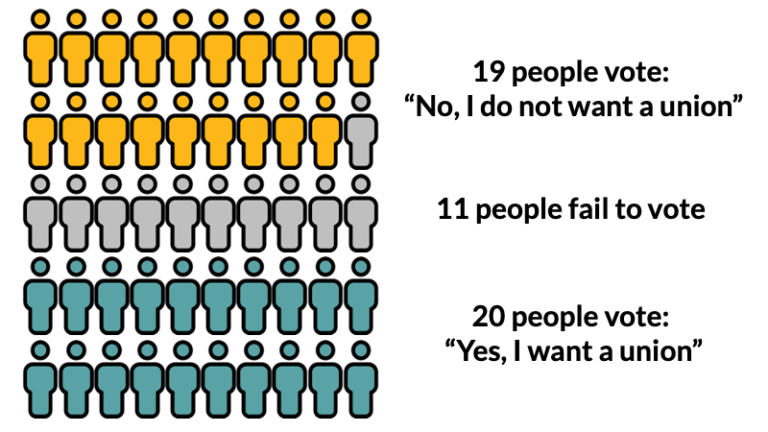
If the union wins: The union becomes your representative for negotiating wages, benefits, and working conditions. You will likely be required to pay money to the union. You could face a strike if the union is dissatisfied with the negotiation process, or if accepted, you could be “stuck with the union for years,” as it is very difficult to remove them.
If the union does not win: You continue to work directly with the company on matters like your pay, benefits, and working conditions. The union must then wait for a year before it can attempt to organize the same group of workers again.
No “trial period” available: Unlike typical political elections, union representation elections do not automatically lead to another vote in a few years to assess the union’s performance. This has been compared to a politician who wins once and stays in office for life. Removing a union is an exceptionally challenging process known as “decertification” that is:
- Long and complicated
- Must be initiated and funded by employees themselves
- Aggressively fought by unions
- Prohibited from receiving any company assistance by law
- Requires dissatisfied union members to independently seek legal advice and navigate complex government rules
Every vote is critical. Be a voter and your voice will be heard on these important choices that will affect your working life for potentially many years to come.